Go back to the core
The employer brand must lead with career growth and effective rewards with job security, not get distracted into discussing “purpose”.

Our Thinking · Research report · 2026
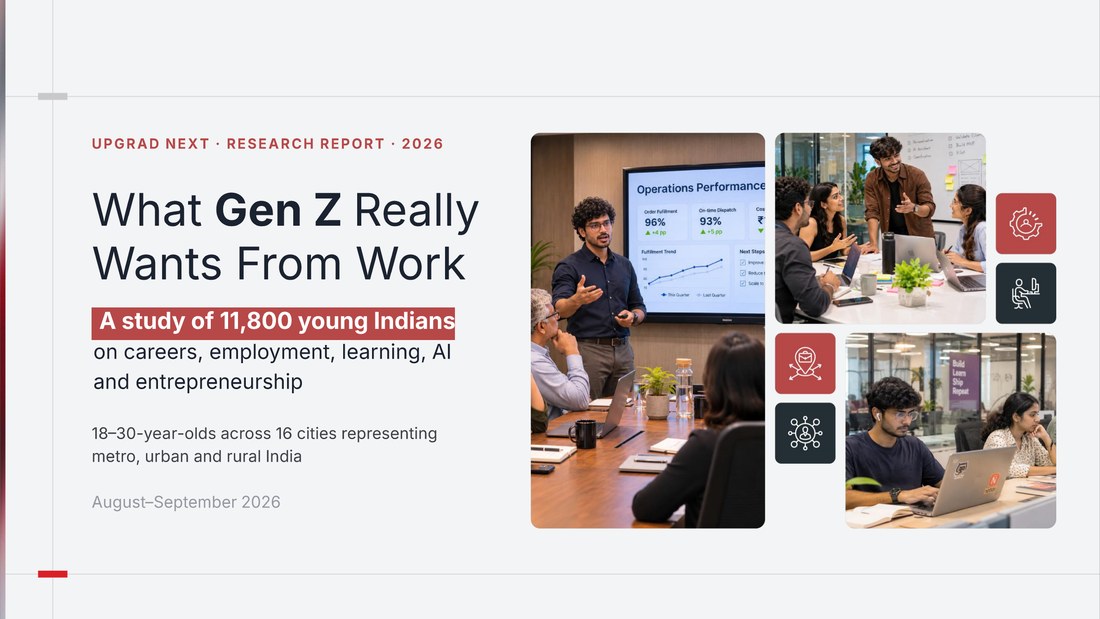
A study of 11,800 young Indians on careers, employment, learning, AI and entrepreneurship. We spoke to 18 to 30 year olds across 16 cities, representing metro, urban and rural India.
Executive summary
Some findings may appear contradictory, but they share one thread: young Indians are building their own safety nets through promotions, skills and the freedom to leave.
51% prefer a fully in-office arrangement and 81% would happily accept a well-paid role even if the work is not interesting. Culture, purpose and flexibility sit at the bottom of their list.
51%prefer to work fully in-office
90% expect a significant promotion within three years and 54% don’t see themselves in their current job beyond two. Limited growth and poor leadership, more than pay, push them out.
90%expect a significant promotion within three years
Learning is an insurance policy: job security is the top reason to upskill. Yet fear is driving this generation, and only 11% have built anything on AI platforms.
11%have built anything on AI platforms
91% call their education effective, yet 99% still have gaps to close. The gap lies in application, and communication is the skill they most want to improve.
99%still have gaps to close before they are truly employable
46% of the rural-raised are extremely willing to join an early-stage startup, against 26% in metros. Mentorship, more than funding or government support, would help them take the leap.
46%of the rural-raised are extremely willing to join an early-stage startup
Implications for organizations
A consistent pattern runs through the data: young Indians take risks when there is a safety net. Six things follow for employers.
The employer brand must lead with career growth and effective rewards with job security, not get distracted into discussing “purpose”.
81% are happy to take a boring job so long as it pays well, a likely sign of tougher job markets that companies must acknowledge.
Guidance and mentorship are a critical need for this generation, far more than packaged learning content.
Career growth is both. Organizations need to communicate how growth happens on both counts.
Link learning visibly to career paths, blend it with hands-on mentorship, and keep it to a couple of hours a week.
Those who fear AI are least likely to enrol or pay. Show the educated sceptics how to add value with AI, not just how the tools work.
Beyond the stereotypes
| The popular belief | What our study shows | What it means for organizations |
|---|---|---|
| The popular beliefGen Z prefers remote work | What our study shows51% prefer fully in-office; only 13% want fully remote | What it means for organizationsThe office is where they expect to learn, be seen and grow |
| The popular beliefThey are driven by purpose more than pay | What our study shows35% rank social impact in their bottom two; 81% would take a dull, well-paid role | What it means for organizationsRewards and growth, not mission statements, win talent |
| The popular beliefCulture decides where they work | What our study showsCompany culture ranks last of ten factors, in the bottom two for 45% | What it means for organizationsCulture matters once they join; it rarely decides the offer |
| The popular beliefOnline learning suits them best | What our study showsOnline courses are the least preferred way to learn (15% rank first) | What it means for organizationsLearning built on content libraries misses the mark |
| The popular beliefMetro youth are the most ambitious | What our study showsRural-raised are far more willing to join startups (46% vs 26%) | What it means for organizationsTalent for growth roles sits well beyond the big cities |
Source: upGrad Next Gen Z survey, August to September 2026 (n=11,800).
The full report
The full report covers all five themes in detail, with cuts by place of upbringing, gender and education, and what the findings mean for employers, educational institutions and policy makers.
Download the full report